Strategic internal communications: Connecting comms to business outcomes


Most communicators know strategic internal communications means connecting comms to business outcomes, but the majority aren’t doing it. The key is uncovering evidence that links comms work to the broader goals your organization is trying to achieve.
In this blog post, Interact’s Senior Content Marketing Executive Sophie Hamblett explains what makes comms strategic and how a data-driven internal comms strategy can connect your work to the outcomes leaders care about.
Summary: Strategic internal communications connects comms work to the outcomes a business wants to achieve, rather than focusing only on delivering messages. Interact and Ragan’s research found just 22% of communicators describe their function as a strategic partner. Teams build that role by defining the business outcome, the employee action it needs, and the evidence that shows it happened.
What’s the difference between strategic internal communications and tactical internal communication
Strategic internal communications are connected to outcomes a business wants to achieve, while tactical internal communications focus on delivering messages. Strategic comms teams often get involved earlier in the process to better understand what employees need to know or do, and collaborate with other teams to build a comprehensive plan.
Most comms teams still aren’t operating this way, at least as often as they could be. In Interact and Ragan’s Employee Experience Mandate research, 51% of respondents described internal communications as only “somewhat strategic,” reflecting on their ability to advise on some initiatives. Another 20% said the function was mostly tactical and brought in to distribute messages. Just 22% described comms as a strategic partner, and only 4% said it was highly strategic with a clear seat at the table.
Take the rollout of a new company-wide process as a real-world example. A tactical comms team may be brought in once the plan is finalized to explain the change and distribute the message. A strategic comms team is involved earlier, working with the teams behind the rollout to understand what different employee groups need to know or do, plan how to support that response, and agree what success looks like.
Here’s how tactical and strategic internal comms compare across that same rollout:
| Comparison point | Tactical comms involvement | Strategic comms involvement |
| When comms gets involved | After a decision has been made and needs communicating | Earlier, while the rollout and desired employee response are still being shaped |
| Who comms works with | The stakeholder requesting the message | The teams behind the rollout, from planning through to results |
| What comms is asked to do | Create and distribute the message | Help determine what employees need to understand or do, and how communication can support |
| What success looks like | The message reached employees and generated engagement | Employees understood or took the action needed to support the wider goal |
| What gets measured | Opens, clicks, page views, and reach | The employee action needed (for example, completion or adoption), with activity metrics as supporting context |
| How results are used | Report how the communication performed | Show what changed and help inform next steps |
Tactical execution still matters within a strategic internal communication plan. The difference is that the role of internal comms extends beyond delivery: messaging becomes one part of a wider plan to support a business goal.
Why should communicators shift their focus to broader business outcomes?
Connecting internal communications to business outcomes helps leaders see where the function contributes value and why it deserves investment. Our Employee Experience Mandate research suggests communicators already recognize this, with 79% stating that clearer connections to business outcomes would make senior leaders more likely to invest.
However, knowing that something is important doesn’t make it easy to do. Thirty percent of respondents said difficulty connecting comms activities to business outcomes was their biggest challenge in proving ROI. Meanwhile, 36% still primarily report activity metrics (opens, clicks, and page views), while 33% don’t consistently use internal comms data at all.
Activity metrics are still valuable for understanding reach and how individual comms tactics are performing. However, they have real limits when treated as broader employee experience metrics, which is why they shouldn’t be used as proof of overall success.
A leader deciding whether to increase budget, expand a team, or invest in an internal communications platform needs more than evidence that content was simply consumed. They need an indication of what employees understood, adopted, or did next, and how that supported the wider business priority. That evidence is what gives communicators a stronger basis for showing the strategic contribution of their work.

How do you connect strategic internal communication to business outcomes?
Connecting strategic internal comms to business outcomes starts with three questions: What is the organization trying to achieve? What do employees need to understand or do to support that goal? What evidence would show whether that change happened? Here’s how to ask each one in practice.
1. Start with the business outcome
Before deciding what to publish, send, or measure, clarify what the organization is trying to change or achieve. That outcome could be increased adoption of a new system, stronger safety compliance, faster onboarding, greater trust during a transformation, or higher participation in open enrollment.
2. Define what employees need to do or understand
Next, identify the employee response needed to support the business outcome. If, for example, your goal is higher participation in open enrollment, employees need to understand why it’s important to participate, know what action is required to do so, and complete enrollment by the deadline.
This creates a much clearer link between the business goal and the communications plan. Instead of asking whether employees engaged with the comms announcing the enrollment period, ask whether they did what the organization ultimately needed them to do: enroll before the deadline.
3. Look at the evidence to determine what happened – and why
Now, you can look at the evidence that tells you whether employees took the intended action. In the open enrollment example, enrollment completion is the clearest indicator of success.
Other metrics such as reach, clicks, recurring questions, and comments about points of confusion provide supporting context. If completion is lower than expected, those additional signals can help explain why. Employees may not have seen or understood the communication, remembered the deadline, or known what action to take. If completion increases, these data points can help build a better picture of what may have supported that result.
Taken together, thes questions move the focus beyond how your comms performed to what your comms achieved. In a data-driven internal comms strategy, activity metrics still matter, but they become supporting evidence within a wider story about employee response and organizational outcomes.
How can better evidence strengthen the role of internal communications?
Better evidence can help demonstrate the strategic role of internal communications by giving comms teams more useful input to bring into business conversations. It doesn’t automatically create strategic influence, but it can help teams show how employees respond to decisions, where communication creates clarity, and where earlier involvement could improve future initiatives.
This gives comms more of a seat at the table. Gallagher’s 2026 Employee Communications Report found that teams connecting data to business impact were less likely to report being perceived as an administrative function.
Our research with Ragan recommends several ways communicators can build stronger evidence and make it more useful in business conversations:
- Ask about the outcome first. Find out what leaders need employees to support, rather than what message they want to distribute.
- Translate comms into business language. Connect your work to outcomes such as adoption, trust, retention, safety, compliance, or reduced confusion.
- Report on what’s changed. Show what happened after communication. For this step, it’s often helpful to establish a baseline for whatever you’re measuring – a tip shared in our Measuring What Matters event.
Bringing employee insight into leadership conversations
Internal comms teams often see the recurring questions, concerns, misconceptions, and feedback that leaders don’t. Bringing those patterns into leadership discussions gives communicators something directly valuable to leadership to contribute: insight into how decisions are landing with employees.
That can help strengthen comms’ influence by showing where confusion is building, where employees need more support, and where earlier involvement could improve future rollouts. Our report specifically recommends using evidence from past communications to demonstrate where comms could help reduce confusion and improve employee response next time.
How do you start building strategic internal communications?
Strategic internal communications should start with the business outcome, not the channel, content, or deliverable. Before planning your next campaign or executing on a stakeholder request, use the three questions to connect the organization’s goal to the employee response you need and the evidence that will show whether communication contributed.
- What business outcome are we supporting?
- What do employees need to understand or do to support it?
- What evidence will show whether that happened?
Answering those questions up front helps keep communication connected to what the organization is trying to achieve and gives you a stronger basis for demonstrating your contribution afterward.
Connecting communication to employee action and business outcomes gives internal communicators a clearer way to demonstrate their contribution. Download From Engagement to Impact: The New Employee Experience Mandate to see where comms teams are struggling to prove impact and how stronger evidence can help strengthen your strategic internal communications.
Make your contributions easier to prove
Download From Engagement to Impact: The New Employee Experience Mandate for the full research and practical recommendations on connecting employee response to business outcomes. Get the report
FAQs
Why do internal comms teams struggle to prove their value?
Most teams report activity rather than outcomes. In Interact and Ragan’s Employee Experience Mandate research, 36% of communicators primarily report opens, clicks, and page views, 33% don’t consistently use internal comms data at all, and 30% said connecting comms activity to business outcomes was their biggest challenge in proving ROI. Activity metrics show reach, but they don’t show what employees did next.
What is strategic internal communications?
Strategic internal communications is communication planned around a business outcome rather than a message to deliver. Strategic comms teams get involved early, work with the teams behind an initiative to decide what employees need to understand or do, and measure whether that happened. Tactical comms focuses on creating and distributing the message once the decisions have already been made.
How do you connect internal communications to business outcomes?
Start with three questions. What is the organization trying to achieve? What do employees need to understand or do to support that goal? What evidence would show whether that change happened? Answering them before planning a campaign links communication to a measurable employee response, such as system adoption or open enrollment completion, rather than engagement alone.
What should a data-driven internal comms strategy measure?
A data-driven internal comms strategy measures the employee action the business needs first, such as enrollment completion, system adoption, or safety compliance. Reach, clicks, recurring questions, and comments then act as supporting evidence that helps explain the result. Setting a baseline before you communicate makes it easier to show what changed afterward.
How can the role of internal communications become more strategic?
Evidence of impact gives comms a stronger case for earlier involvement. Gallagher’s 2026 Employee Communications Report found that teams connecting data to business impact were less likely to be seen as an administrative function. Communicators can also bring leaders insight they don’t otherwise see: the recurring questions, concerns, and confusion that show how decisions are landing with employees.
You Might Also Like
 Blog
Blog 3 essential intranet AI capabilities every organization should expect
Intranet AI capabilities can look impressive in a demo. The real question is whether they still work in the real world, when employees have…
 Blog
Blog How to measure employee engagement – and why
Knowing how to measure employee engagement has never mattered more, and the answer is within reach of every internal comms and EX leader.

 News
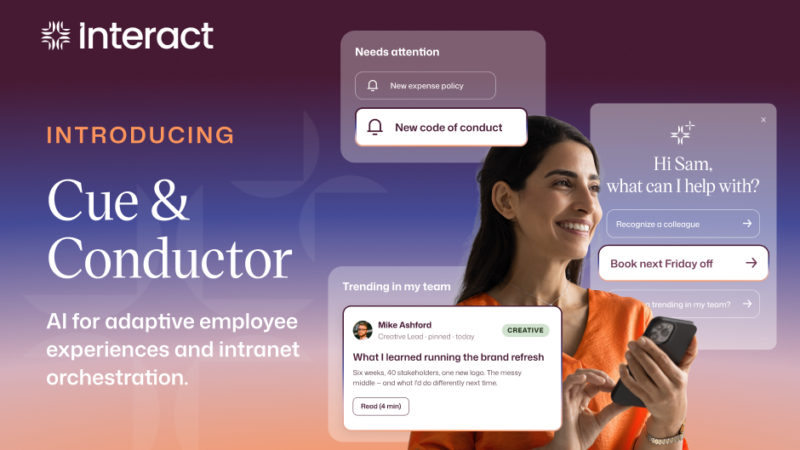
News Interact launches Cue and Conductor to create an AI-native intranet that adapts to what every employee needs next
Interact has launched Cue, an adaptive AI intranet experience that personalizes what every employee sees, knows, and does next. Cue launches alongside Conductor, Interact’s…

 News
News 62% of communicators say meaningful engagement includes employee action, but only 8% connect the data
New research from Interact and Ragan Communications identifies an “action-to-decision gap” between the outcomes internal communications teams want to influence and what their current…