What is a modern intranet? What enterprise buyers should look for


A modern intranet is cloud-based, mobile-first digital hub that employees can use to communicate, find information and access productivity-boosting tools.
Unlike traditional intranets, which were little more than static document libraries, modern intranets are interactive digital workspaces that employees can access from anywhere at any time.
In 2026, enterprise buyers are no longer asking ‘do we need an intranet?’ They’re looking for solutions that measurably improve productivity. As more intranets adopt and integrate AI tools, the line between a useful and a bloated solution can become blurred; the difference usually comes down to how AI is actually used.
Summary: A modern intranet is a cloud-based, mobile-first employee experience platform that targets news and knowledge by role, location, and team, answers questions from governed content, and measures whether messages drive action. Enterprise buyers should prioritize frontline reach, personalization, answer-based search, action-focused measurement, integrations, governance, and AI that is native rather than bolted on.
Key takeaways
- The rise of hybrid work has seen intranet adoption increase, but the average employee spends only six minutes per day on their company’s platform.
- A useful modern intranet will provide a personalised employee experience, not act like a static document store.
- AI tools have been shown to boost productivity by 40%, but 86% of workers aren’t confident in their reliability.
- AI-powered intranets have features bolted-on; AI-native intranets build AI into their foundations.
- When comparing modern intranets, consider whether AI tools actually help employees, or only provide surface-level benefits.
What is a modern intranet?
A modern intranet is a personalised, mobile-first employee experience platform built to make finding information and performing tasks more streamlined. An effective platform will also provide communications, HR and IT teams the tools they need to check in with staff and measure the impact of their work in real time.
Legacy intranets were little more than digital storage systems. Documents could be uploaded for safekeeping, but they weren’t typically designed to make finding information easy.
Modern company intranets look to address this problem by automatically connecting information to the right people at the right times; they do this by:
- Targeting news and resources by role, location and team, so people always have access to the content they need.
- Being accessible to both in-office and remote employees through secure on-site and mobile devices.
- Providing answers from governed sources through search rather than a cumbersome page of links.
- Updating leaders when a message is read, understood and acted on.
- Sitting inside the systems employees already use to provide a portal to a wider digital workspace.
How useful a modern intranet is can be judged by how well it addresses the seven pillars of employee experience:
- communication
- alignment
- knowledge
- self-service
- community
- tool access
- recognition
A single-purpose tool serves one pillar well; an enterprise-grade platform must serve all seven in one centralised space. This is why modern intranets are often referred to as employee experience platforms.
Interact is designed to map the seven pillars of employee engagement directly to business outcomes, the goal being to provide employees with the tools they need to drive organisations forward.
Are intranets still relevant?
Yes, more so than ever.
With more than 90% of UK businesses offering some form of flexible work, the need for a unified, remote-accessible source of organisational knowledge has never been greater; but that’s only one reason why intranet adoption keeps increasing.
Common reasons cited by enterprise buyers include:
- Knowledge consolidation: As AI and tool sprawl multiply the places an answer can come from, employees need one governed, current source they can rely on.
- Employee engagement: Modern intranets provide employees access to the right tools and data at all times, helping to address declining levels of employee engagement.
- Remote accessibility: Deskless and frontline employees, often the majority of an enterprise workforce, are the hardest to reach and the most likely to miss email and desktop notifications.
- Real-time visibility: Through analytics and real-time notifications, leaders can see how tasks are evolving and where resources are best allocated, helping them to make informed decisions.
The takeaway for leaders is that an effective modern intranet will be centralised, engaging, accessible and data-driven.
AI-native vs AI-powered: the distinction that matters most
With almost 90% of organisations now using AI to support at least one business function, it’s no surprise that most intranets boast some form of AI functionality.
The problem for business leaders, however, is that AI can be used in many ways; a solution can be presented as AI-forward without its tools providing much practical use. To break through the marketing buzzwords, it’s important to understand the difference between an AI-powered and an AI-native intranet.
What is an AI-powered intranet?
An AI-powered intranet is an older platform that a vendor has added AI features to over time. A chatbot answers a few questions, a summariser shortens an article, a writing assistant drafts a post. These features can help to save time, but are often surface-level, white-labelled tools. This is why feature lists advertised by many popular platforms often look very similar.
What is an AI-native intranet?
An AI-native intranet is a new platform that’s been purpose built to integrate AI into its own unique features and workflows. The AI is grounded in the organisation’s own governed content and honours existing permissions, so it provides employees only with information they need and are allowed to see. AI-native platforms can adapt to meet the unique needs of each organisation.
The table below shows the practical difference from a buyer’s perspective:
| Function | AI-powered (added on) | AI-native (built in) |
| Queries | Answers are drawn from general model knowledge. | Answers are drawn from your governed content within each employee’s permissions. |
| Content | The platform can summarise content and create drafts for employees to fine-tune. | The platform can complete actions within your defined ruleset and request human approval before scheduling. |
| Governance | Bolted on after the fact. | Built into the workflow, auditable at each step. |
| Oversight | Employees are required to review outputs to ensure they meet the business’ requirements. | The platform builds outputs around unique business requirements; the team approves at the final step. |
By taking the AI-native approach, a business can not only improve efficiency, but also trust their intranet to perform actions in line with its own rules, standards and policies.
Interact builds AI into the platform this way. Cue, the employee-facing assistant, answers a question in plain language and links to the source, drawing only on content the person already has permission to see.
Conductor, the operator layer, turns a goal like a policy that must be read before it comes into effect into a full sequence of events, spanning mandatory read, reminder, manager follow-up, and completion reporting. Each step is editable and human approval is required before the process is completed.
With an AI-native platform, the intranet becomes a practical part of the business’ workflow, much more than a tool that needs constant oversight to get things right.
What enterprise buyers should look for in a modern intranet
Once the AI-powered vs AI-native distinction is clear, all it takes to determine the right platform for any given organisation is to look for a few specific features and capabilities.
Score each platform against your own workforce, and weigh the criteria by what your people actually struggle with.
Reach for every employee, including the frontline
Look for:
- A native mobile app that supports publish-once delivery to email, chat and digital signage.
- Content that reaches shared and frontline devices to ensure the whole workforce receives updates when they need them.
Personalisation without engineering tickets
Look for:
- Automated content targeting by role, location and team.
- Scheduling systems that communications and HR teams can freely adjust without requiring an engineering ticket.
Search tools that provide answers and knowledge
Look for:
- Platforms that provide answers with a link to its governed source, not just a page of blue links.
- Search tested against your own messy content and connected systems rather than the vendor’s clean demo data.
Measurement that proves action beyond reach
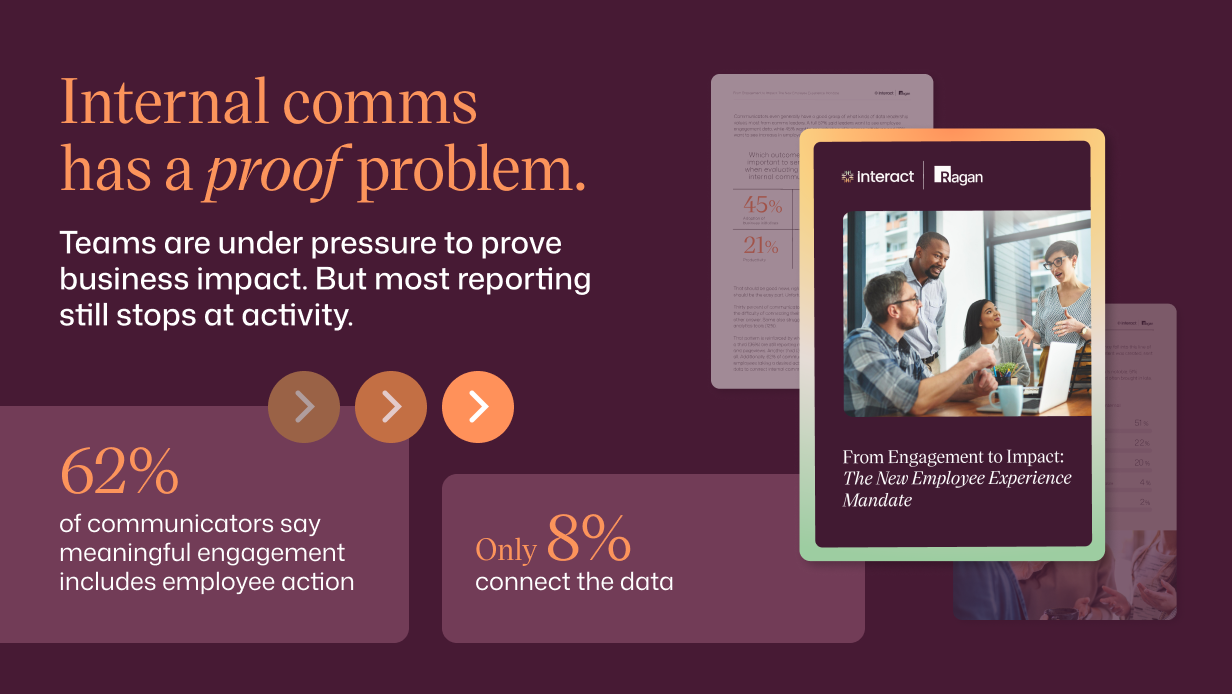
A useful intranet will provide measurements that prove its worth. Research from Ragan and Interact, based on responses from more than 200 communicators, found that:
- 62% say meaningful engagement includes employee action.
- 8% connect their communications data to those actions.
- 6% regularly use internal communications metrics to support investment decisions.
A modern platform should report read rates, acknowledgment and sentiment to give a line of sight from a message to the action it produced. This way, teams can measure the efficacy of current workflows and make adjustments that drive real improvements.
AI that is native, grounded and governed
Ask each vendor:
- Where does the AI get its answers?
- Does the platform respect existing permissions?
- Can the platform act or only draft content?
- Does the platform require human approval before anything is published?
Integration with the tools you already use
Look for:
- Native connections to Microsoft 365, your HR system and your service desk.
- The specific integrations you depend on, confirmed rather than accepted from a long logo wall.
Governance, permissions and security
Look for:
- Granular permissions and content governance.
- A clear method for keeping content current and owned to avoid issues with duplicate and outdated pages.
- An AI that stays inside the permission model.
How a modern intranet proves its value
The business case rests on evidence; Ragan and Interact’s research shows where most teams fall short. Reach can be measured through open and read rates, but measuring the impact of communications on real business activity is much harder.
A platform earns its budget by closing that gap. Fewer support tickets, faster onboarding, higher retention and measurable participation in the moments that matter all show up in numbers a finance leader recognises. When you shortlist, ask each vendor to show how a real customer moved from measuring reach to measuring action.
FAQs
What is a modern intranet?
AnsweA modern intranet is a cloud-based, remote-accessible platform that connects employees through knowledge sharing, communication and collaboration tools. An effective platform will be accessible to all employees, capable of measuring whether messages are read, understood and actioned and customised to meet unique business needs.r goes here
Are intranets still relevant in the age of AI?
Yes, intranets have evolved in the age of AI, past their traditional use as document storage systems, to become interactive, feature-rich digital workplace platforms. As AI and tool sprawl multiply the places an answer can come from, employees need one governed, current source they can trust. Analysts describe the intranet re-emerging as the front door to the digital workplace for that reason.
What is the difference between an AI-native and an AI-powered intranet?
An AI-powered intranet adds AI features, such as a chatbot or a summariser, on top of an older platform to assist a person who still does the work. An AI-native intranet is built around AI that is grounded in your governed content, respects existing permissions and can carry out multi-step actions with human approval.
What should enterprises look for when choosing a modern intranet?
Prioritise reach to the frontline, personalisation without developer tickets, search that gives answers, measurement that connects to action, native and governed AI, integration with your existing systems and enterprise-grade governance and security.
Where to start
A modern intranet in 2026/2027 can provide a personalised, measurable, AI-native front door to work, but not all platforms are created equal. The clearest way to identify a genuinely useful solution is to determine how the platform actually uses advanced tools to enhance real workflows.
The best place to start is to score your options against your own hardest reach and governance requirements and run a proof of concept with real content. To see how an AI-native platform actually handles the toughest requests, click here to book a demo and bring the message you’ve always struggled to land.
You Might Also Like
 Blog
Blog What’s shaping internal comms in 2026/27: State of the Sector survey
Have your say in Gallagher’s State of the Sector survey How effectively does communication translate into what employees actually believe, experience, and do, and…

 Blog
Blog What leaders need to see to prove the value of internal communications
Proving the value of internal communications is about showing how comms contributes to the things leadership already cares about. It requires combining communication data…

 Blog
Blog Strategic internal communications: Connecting comms to business outcomes
Most communicators know strategic internal communications means connecting comms to business outcomes, but the majority aren’t doing it. The key is uncovering evidence that…
 Blog
Blog How to measure employee engagement – and why
Knowing how to measure employee engagement has never mattered more, and the answer is within reach of every internal comms and EX leader.