Digital signage solutions: your one shot to reach every employee

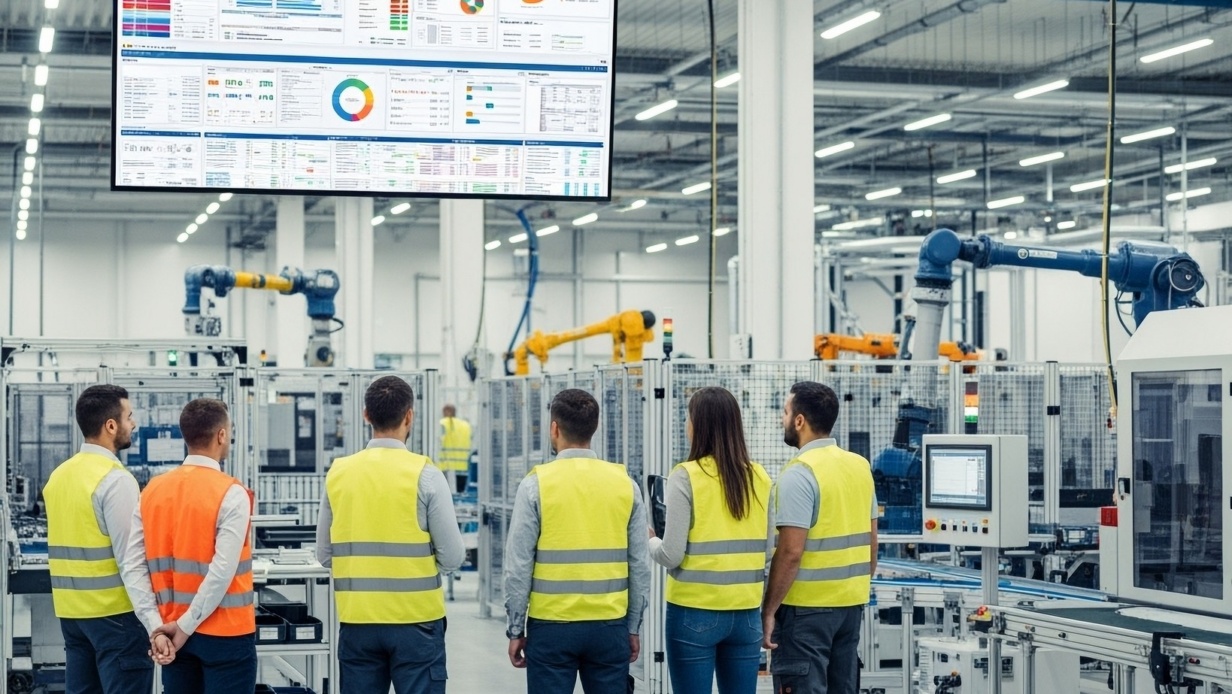
Digital signage solutions answer a problem most internal comms and IT leaders know too well: a huge share of your workforce never sits at a desk. Warehouse, shop floor, and frontline staff rarely log into the intranet. You often get one shot to reach them as they pass a screen, and making that brief moment count is where digital signage pays off.
What are digital signage solutions, and why do they matter?
Digital signage solutions are tools that push company content to physical screens across your sites, turning blank displays into a live internal communications channel. In 2020, reports showed around 2.7 billion people doing the kind of jobs that kept them on their feet, on the road, or on a shop floor. For years, that enormous segment of the workforce was given software that was specifically designed for office staff. And yet despite that disadvantage, organizations everywhere have a real opportunity.
Here’s what’s already true. There’s a screen in your reception. There’s probably one in the corridor and one in the break room. Probably one hanging over the heads of people who walk in and out of the office thousands of times each year. And right now, those screens are either looping a slideshow that offers very little – or are doing nothing. Sitting dark in some of the highest-traffic real estate you own.
Digital signage solutions switch this channel on. You write the message once, in the intranet, and then promote it everywhere you need it to be. You don’t duplicate it. You don’t reformat it. You don’t file a design request and wait days for multiple versions that no one will read. One platform, one workflow, fewer tools to worry about.
More importantly you stop hoping people will chance upon information via word of mouth, and you start talking directly to them where they already are. The warehouse floor, the construction site, the physical world they work in every single day, all become part of a wider employee communication platform.
Why deskless and frontline worker communication is a one-shot game
“Almost half cannot name their CEO, and half feel their employer cares more about office workers than about them. “
Deskless and frontline worker communication is a one-shot game because these employees rarely get the repeated digital nudges that office staff receive so routinely. They have no inbox to refresh through the day. No intranet tab open in the background. Often there’s just a short window of time in front of a screen as a shift starts or a break ends.
Getting that moment right is the difference between a comms strategy that reaches everyone and messages that disappear. The cost is bigger than it looks. A survey of more than 7,500 frontline workers, found that 87% are not sure their company culture even applies to them, almost half (46%) cannot name their CEO, and half feel their employer cares more about office workers than about them. Among the multiple signals that these statistics surface, it’s a sign that frontline staff feel invisible. They are not being reached.
Without the luxury of a permanent, static digital touchpoint (in old-school speak: a computer or laptop), the break room screen or the display by reception becomes the entire daily conversation with their employer. That is the heart of effective frontline worker communication: treat every screen-view moment as if it’s the only one you will get, because very often, it is.
How do digital signage solutions reach workers that email and intranet miss?
Digital signage solutions reach deskless workers by meeting them in shared physical spaces instead of waiting for them to log in. A screen in a warehouse, a screen in a break room: no passwords, no personal device requirement, no inbox to check. It shouts your message to whoever walks past. That’s it – that’s the whole trick, and if it sounds simple, it is.
Email asks for an account, and then it asks for the habit of actually checking the account. The intranet asks for a login. The mobile app asks for a device and then to install an app. Every one of these channels – valuable though they are in their own right – makes a request before it makes your point. Every request is a door, and behind every door are people you’re losing:
| Channel | Reaches deskless staff without a login | Real-time delivery | Location-specific targeting |
| Company email | No, needs an account | Yes | Limited |
| Desktop intranet | No, needs a login | Yes | Yes |
| Mobile app | No, needs an app and account | Yes | Yes |
| Digital signage | Yes, no login or device required | Yes | Yes, by site or screen |
Sure, a signage tool externally managed from the intranet will reach the same people. It’ll tick the same box, but then it will create a second job that could have been avoided: now somebody has to manage content that already exists, in a separate system, and rebuild it for your standalone platform. Ignoring the IT problems you’ll run into, you’ve just swapped the problem of reach with the problem of additional busywork.
A native approach doesn’t make that trade. You craft your message in the intranet, and it goes straight to the screens you select. The same person who owns the message also owns the channel, which is exactly how the best digital comms strategies work. Reach goes up, workload doesn’t.
What makes digital signage an effective internal communications channel?
Digital signage works as an internal communications channel because it combines unavoidable placement with repeated exposure. Screens sit in the spaces people pass every day, so a message is seen time and again without anyone having to actively open it.
There is evidence for this. Out-of-home advertising, which is the industry’s term for messaging on screens in physical spaces, produces the highest recall of any media channel. So picture the workplace version: a rotating playlist in a busy corridor keeps a safety reminder in front of people for their entire shift, not for the half-second it takes to notice, and then delete, an email. Message placement does the work that inbox behaviour can ignore.
Good digital signage solutions do three more things, turning a passing glance into something that counts towards business value.
- QR code: A passing employee can scan and act, and you get real click-through data by channel, by device, and by group.
- Location channels: Keep content relevant so each team sees what they need – and crucially don’t see what they don’t.
- Scheduling with automatic expiry: Content arrives on time, leaves on time and doesn’t ever accidentally produce an old event or a notice that went out of date last month.
Digital signage solutions give you reach, relevance and proof via a channel that people can’t help seeing every day.
Six ways to put digital signage solutions to work
The quickest way to see the value of digital signage solutions is to match screens to the spaces your people already occupy. Each location has a job to do, and here are six examples that consistently earn their place.
- Welcome people at reception and in lobbies. Greet new starters by name, brief visitors, and put your values and recognition front and center the moment someone walks in.
- Turn break rooms into a news hub. The one place almost everyone passes. Use it for company announcements, team news, wellbeing initiatives, benefits, and even the weekly menu.
- Keep the shop floor safe and informed. This is where the one-shot rule really pays off. Push safety updates, compliance reminders, shift information, and team targets to warehouse, manufacturing, and shop floor screens, in real time, to people who will never see an email about them.
- Recognize employee frontline achievements in public. Put names and milestones on the screen where colleagues can see them. Visible, timely recognition is one of the simplest ways to close the gap frontline teams feel most.
- Bring data to the office floor. Embed live BI dashboards and broadcast quarterly updates and HR campaigns, so desk-based teams stay connected to the numbers and the narrative.
- Localize across multiple sites. Create dedicated channels for each region, country, or building, deliver locally relevant content, and manage every screen centrally from one platform.
How do digital signage solutions drive employee engagement and results?
Digital signage solutions drive employee engagement by including every worker in the same story, not just the people at desks. When a warehouse team sees the same priorities, recognition, and updates as head office, work feels connected to something bigger.
That alignment and inclusion pays off. Gallup’s analysis is consistent on this: the most engaged businesses deliver around 23% higher profitability and 18% higher productivity than the least engaged. Engagement does not happen in teams you cannot reach, so consistent communication is the precondition, and for frontline staff, digital signage is often the only channel that delivers it.
And this runs straight into Interact’s employee experience framework. Communication comes first, because it’s the channel that carries trust – and there’s no trust in a message that nobody reads. Community is second, and it grows only when culture and recognition are visible to everyone – including the people on the night shift, the remote sites, and the people keeping the organization running while everyone else is at home. Finally, Alignment, which takes hold when the work on the floor is tied to the message on the screen. With digital signage solutions as a native part of your comms structure, built-in analytics show what’s seen, what’s engaging, and what’s acted on. You never have to assume or guess the connection. You prove it. Better employee engagement isn’t just a feeling, a once-a-year survey exercise, it’s an outcome that happens when you finally reach your whole workforce on a channel built for them.
Digital signage solutions reach the people you most need
The people you most need to reach are often the hardest to catch. A worker in a warehouse. A nurse between rounds. A team grabbing ten minutes before the next shift. Every one of them is a single, fleeting chance to spread the message that’s important to an organization – and you get one chance. That’s the whole argument for treating digital signage as a one-shot channel and grabbing the moments it is built to serve.
Done right, it closes the gap between what you send and who ever sees it. If you want to know what that looks like across your own sites, our employee experience experts can show you. Book a demo, let’s talk, and build digital signage solutions that leave nobody out.
FAQs
What are digital signage solutions, in simple terms?
They are tools that broadcast your company content to physical screens across your locations. Instead of looping generic visuals, those screens display news, safety messages, recognition, and data drawn straight from your intranet. The best options are native to the intranet, so communicators publish once and the content appears on the right screens automatically.
How do I reach employees who don’t have a company email or intranet login?
Reach them where they already are. Digital signage solutions show company content on screens in warehouses, break rooms, receptions, and shop floors, so deskless and frontline staff see updates without an account, a device, or a login. Pair signage with a mobile app for personal reach, and you cover almost everyone.
Do digital signage solutions require new hardware or IT support?
Not much. Most setups run on a low-cost media player or stick PC, or on any smart TV using a public URL, so there is no specialist kit. With a native, intranet-integrated tool, communicators manage everything themselves, which keeps IT out of the day-to-day and avoids the duplication a separate signage system creates.
How do I measure whether anyone actually sees digital signage content?
Use built-in analytics and QR codes. Analytics show how content performs by channel, device, and user group, while QR codes let employees scan to act, turning a passive glance into a tracked click. Together they reveal which screens, locations, and messages drive engagement, so you can refine what you show and where.
Will digital signage replace our other internal communications channels?
No. Digital signage is one channel in a wider mix, strongest when it works alongside email, mobile, and the intranet rather than instead of them. Think of it as the layer that finally reaches your deskless audience. As workforces stay distributed and frontline-heavy, expect screens to become a permanent part of the internal communications channel toolkit.
You Might Also Like
 Blog
Blog Nine questions to ask intranet vendors: A checklist for your next demo
An intranet demo is designed to make the product look good. It’s easy to walk away impressed, especially now that AI is typically part…

 Blog
Blog Strategic internal communications: Connecting comms to business outcomes
Most communicators know strategic internal communications means connecting comms to business outcomes, but the majority aren’t doing it. The key is uncovering evidence that…
 Blog
Blog 3 essential intranet AI capabilities every organization should expect
Intranet AI capabilities can look impressive in a demo. The real question is whether they still work in the real world, when employees have…
 Blog
Blog How to measure employee engagement – and why
Knowing how to measure employee engagement has never mattered more, and the answer is within reach of every internal comms and EX leader.