Personalized employee experience isn’t a comms strategy. It’s a respect strategy.


A personalized employee experience treats each person as an individual with a specific role, location, and set of priorities, rather than as one of thousands of identical recipients or roughly divided segments created manually. When organizations deliver irrelevant content at scale, they send an implicit message of disregard. AI now makes genuine relevance possible without overwhelming comms or IT teams.
A personalized employee experience starts with a deceptively simple idea: when every employee opens the same generic update, the implicit message is pretty clear: we don’t really know who you are, and we don’t think it’s important to find out.
The conversation about workplace personalization has been stuck in marketing tactics for too long. This post, by Interact’s Senior Content Marketing Executive Sophie Hamblett, reframes it as something more fundamental than that, and shows how AI now makes it possible at scale.
What is a personalized employee experience?
A personalized employee experience reflects what each person does in their role, where they sit (or nowadays stand or drive!), what language they prefer, and what they need to do their job. It turns their homepage, search results, news, recognition, and daily tools into a bespoke, personal, and role-specific set. In a 10,000-person organization, that means a frontline retail worker shouldn’t get the same intranet update as the CFO. It’s not because either one matters more, but because their context, needs, and behavior patterns are different.
The term “personalization” has longtime marketing connotations. Most people have been on the receiving end of the consumer version. We’re sure you’ve gotten plenty of cheerful “Hi [First Name]” emails, which often fall apart the moment you read the second paragraph.
Even though marketing tactics have improved, when comms and HR teams start talking about a personalized employee experience, it’s understandable that people brace for the same thing: a thin friendly layer on top of company-wide broadcasts that aren’t at all tailored to the recipient.
The workplace version of personalization means something different, or at least it should. Employee personalization needs to steer away from the surface-level dressing on a one-size-fits-all message. Content and messaging should adapt to the person receiving it, and that difference should be apparent across every area of the digital workplace, from the intranet homepage to email newsletters to employee surveys.
Why one-size-fits-all communications send the wrong message
When every employee receives the same content regardless of role, location, or function, the message is pretty obvious to the recipient: we haven’t bothered to figure out who you are. Over time, that signal accumulates and becomes a negative factor in employee trust, engagement, and turnover.
The data on this is sobering. Microsoft’s most recent Work Trend Index research found that employees using Microsoft 365 are interrupted roughly every two minutes by meetings, emails, and notifications, and that nearly half describe their work as chaotic and fragmented. A significant number of these interruptions are irrelevant, stealing recipients’ focus and morale as they roll in.
“Employees are sick of receiving comms that aren’t relevant to them.”
It’s not that the problem isn’t front of mind for communicators and HR pros. According to Gallagher’s 2026 Employee Communications Report, only 18% are satisfied or very satisfied with their ability to personalize communications. Those surveyed in Gallagher’s report also named audience burnout as the number one risk to their team’s success. Employees are sick of receiving comms that aren’t relevant to them. Personalization doesn’t put a stop to all notifications, of course, but it reduces the volume and ensures that the interruptions that do happen are worth the employee’s time.
When everyone is interrupted by the same things all the time, it’s a clear signal to a workforce that respect isn’t high on the agenda.
What does a respectful level of personalization look like in practice?
Respect, in the context of a personalized digital employee experience, is simply relevance applied consistently. It means the homepage you open in the morning reflects what’s happening in your part of the business. It means your intranet search bar understands your role and the permissions that come with it. It means company updates arrive in the language you think in. It shows that your organization sees you, values you, and wants to speak to you as an individual.
This contrast becomes obvious when you see the difference between a generic experience and a personalized one across the touchpoints that employees notice every day:
| Dimension | Generic experience | Personalized employee experience |
| Homepage | The same news block for everyone, regardless of role or location | Prioritizes tasks, updates, and content tied to the person’s role, region, and current priorities |
| Search | Returns the same results no matter who’s asking | Understands intent, respects existing permissions, and pulls from connected systems |
| Mass emails with broad subject lines and personalization that stops after the greeting | Targeted messages routed by function, region, or shift pattern | |
| Language | English-only, with translation as an afterthought | Each person receives content in their preferred language by default |
Achieving this level of personalization seems like a big undertaking, but in 2026, none of this requires building a separate intranet experience for every employee manually. With a full-featured employee experience platform, individual context can shape what each person sees in their digital workplace, without throwing additional work on overextended comms and IT teams.
How does AI make personalized employee experience possible at scale?
According to Gallagher’s 2026 Employee Communications report, over 60% of communicators and HR professionals cite lack of time as the most common barrier to executing human-centered comms, including personalization.
This finding makes sense when we talk about manual personalization, which has always been inefficient. Manual personalization at the scale of a global workforce means segmenting people into three or four broad personas and calling it tailored.
True personalization, on the other hand, means internal communications and the digital workplace adapting to who someone really is, including their role, their location, their language, or the questions they keep asking, without comms or IT teams having to manually slice and route every message.
AI is what can turn this level of personalization into a workable reality.
This is the principle we had in mind when we built Interact’s AI-powered intranet features. AI-powered search understands the intent behind a question, rather than simply matching keywords. It can pull permission-aware answers from PDFs, handbooks, and connected systems like SharePoint and ServiceNow without the employee needing to know which repository owns what.
Pulse surveys translate automatically into each respondent’s preferred language. This means that no one feels their opinion matters less, and that feedback from a global workforce isn’t just from whoever happens to speak the language of HQ..
Permission-based controls on email and workplace social feeds mean sensitive communications reach the right audiences without leaking to the rest of the organization. They also prevent employees from clicking on a link and hitting a frustrating dead end because they don’t have access.
AI features like these allow organizations to build at scale a communications strategy that cares about who someone is, without the cost growing with headcount. They create processes that separate a genuine personalized employee experience from just another targeting tool nobody in IT has time to configure, nobody in internal comms has time to use, but every employee can see straight through.
Five ways to build a more personalized employee experience
Building genuine employee communications personalization is a sustained shift. It doesn’t happen overnight, but here are five places to start shaping, delivering and measuring your content.
1. Audit how much of your content is identical for everyone
Look at what’s been published this month and ask honestly how much of it is genuinely relevant to the people receiving it. Most organizations discover that homepage content, all-staff emails, and pinned posts are written for an imaginary average employee who doesn’t exist anywhere. A useful test: look at your intranet homepage and ask whether anyone could tell which role or department it was intended for. If the answer is no, you’ve got your first data point.
2. Map the dimensions that matter
Personalization fails when organizations try to tailor everything to everyone, or when they tailor by dimensions that don’t change behavior. The dimensions that consistently matter for employees are role, location, language, function, and lifecycle stage (for example, a new starter has different needs than a ten-year veteran). Pick three or four as your baseline and monitor how well you’re personalizing across them.
3. Explore using AI to expand relevance without additional effort
The hardest objection to personalization is that it sounds like more work, and that’s true when it’s done manually. But this is where AI comes in. Rather than your comms team writing five versions of the same update, AI can adapt content delivery, surface the most relevant items for each recipient, and translate into preferred languages automatically. The work shifts from manual segmentation to designing rules and reviewing performance, freeing up more time for meaningful strategy and other areas of comms.
4. Make translation the default rather than an afterthought
Language is a core part of human experience, and a truly personalized intranet treats it as such, not just a bolt-on for international colleagues. If 12% of your workforce speaks Spanish at home, an English-only update isn’t reaching them as comfortably as it’s reaching their colleagues. It adds an extra layer of cognitive friction every single time, which can limit engagement and belonging. In place of this invisible but very real barrier, modern intranet personalization tools can translate pages, posts, and surveys automatically, giving every employee the experience they deserve.
5. Look beyond opens and clicks by measuring relevance
Open rates and clicks tell you what got noticed, but they don’t always tell you what was useful to employees. Pair traditional comms metrics with measures of relevance: search success rates (what people are looking for and whether they find it), help desk ticket volume (if content was generic when it should have been targeted, employees will need more assistance), and pulse survey questions on relevance, all broken down by audience.
What’s at stake when personalization fails?
According to Gallup’s State of the Global Workplace research, global employee engagement has now declined for two consecutive years, with the productivity cost of disengaged employees measured in trillions of dollars worldwide. Behind that number are millions of moments every day where employees concluded that their organizations weren’t paying attention to them and didn’t value them as individuals.
A personalized employee experience won’t fix engagement on its own, but the absence of it is one of the factors that almost certainly makes things worse. It’s also one of the factors that is most fixable. The organizations getting this right understand that personalization at scale requires systemic action. Many of them are successfully deploying AI that understands context, integrations that pull from where work really happens, and governance that keeps the whole thing trustworthy.
These organizations have realised that in an age of constant content and an avalanche of entertainment, the question is no longer “Did people open that email?” but rather “Did we deserve their attention?” A harder question, but the one that drives real change.
What to do next
A personalized employee experience isn’t built in a single sprint, and it isn’t a one-time project. Organizations that know what they’re doing treat personalization as an ongoing practice: continuously auditing what’s working and refining what isn’t. And more and more are now trusting AI to handle the scale that humans can’t.
If you’re ready to make a personalized employee experience the standard at your organization, here are three places to start:
- Get our free guide on how communicators can embrace AI. It’s full of expert tips and best practices on deploying AI the right way, including for personalized comms.
- Read up on other ways AI is reshaping the workplace. Our blog on how AI is changing the workplace covers the broader trends shaping how work gets done today.
- Talk to our team. If you want to see what a genuinely personalized employee experience looks like in practice, we’re ready to show you around.
Frequently asked questions
A personalized employee experience tailors the content, communications, search results, and tools each person sees to reflect their role, location, language preferences, and current priorities. Rather than treating every employee as a generic recipient of the same content, it adapts the digital workplace to the individual, treating context as a first-class input rather than an afterthought.
When employees keep receiving content with no connection to their role, the implicit message is that the organization doesn’t know them. Trust erodes, and engagement follows. Recent research has found that employees are interrupted every two minutes on average, and comms leaders see audience burnout as the number one risk to operational success. By delivering relevant comms that treat employees as individuals, organizations can reduce mental load and increase engagement with the content that actually matters to them.
AI makes intranet personalization possible at scale. It can route content to the right users automatically, translate communications into each employee’s preferred language, surface relevant search results across connected systems, and learn from behavior to keep recommendations sharp. The result is genuine relevance without comms or IT teams manually slicing and segmenting thousands of employees one update at a time.
Start with an honest content audit. How much of what currently goes to all employees is genuinely relevant to all of them? Map the dimensions that actually matter (think role, region, language, function, lifecycle stage) and use AI to apply targeting rules without adding manual effort. Then measure relevance rather than just opens. Personalized internal communications start with that disciplined honesty.
A truly personalized intranet anticipates rather than reacts. AI capabilities surface what matters before employees go looking, translate content automatically into preferred languages, and tailor experiences down to the individual level. The shift is from broadcasting information at people to genuinely understanding each person and respecting their time accordingly.
You Might Also Like
 Blog
Blog How AI is changing the workplace in 2026
How AI is changing the workplace may be the defining employee experience question of 2026. Now that the experimentation phase of AI is over,…
 Blog
Blog 3 essential intranet AI capabilities every organization should expect
Intranet AI capabilities can look impressive in a demo. The real question is whether they still work in the real world, when employees have…
 Blog
Blog How to measure employee engagement – and why
Knowing how to measure employee engagement has never mattered more, and the answer is within reach of every internal comms and EX leader.

 News
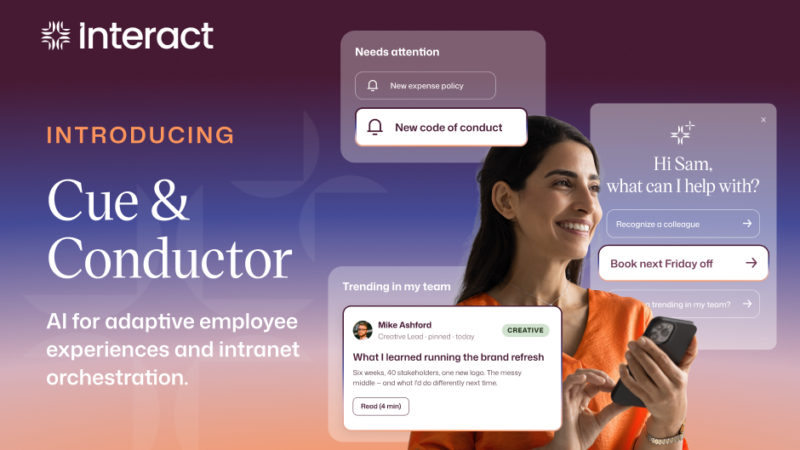
News Interact launches Cue and Conductor to create an AI-native intranet that adapts to what every employee needs next
Interact has launched Cue, an adaptive AI intranet experience that personalizes what every employee sees, knows, and does next. Cue launches alongside Conductor, Interact’s…
