
The enterprise AI governance gap: Why so much AI isn’t enterprise-ready


Enterprise AI governance isn’t keeping pace with AI adoption. Organizations are deploying AI tools at speed, and HR, IT, comms, and senior leaders are discovering that the technology they bought to enhance productivity is creating new risks around compliance, content accuracy, and trust. In this piece, Sophie Hamblett, Interact’s Senior Content Marketing Executive, gets to the heart of the issue: what is the governance gap, why so many AI tools fall short, and how organizations can avoid it.
What is the enterprise AI governance gap?
The enterprise AI governance gap is the distance between how fast enterprises are adopting AI and their capacity to govern it. That capacity rests on two things: the strength of an organization’s internal governance (the policies, ownership, and oversight that shape how you deal with AI) and the ability of the AI tools it deploys to adhere to, enable, and enforce that governance.
The pace of adoption is leaving enterprise governance capacity behind. Three in four organizations admit their governance hasn’t kept pace with AI adoption, according to Informatica’s CDO Insights 2026. At the same time, worker access to AI rose by 50% in 2025, according to Deloitte’s State of AI in the Enterprise 2026. In short, tools are accumulating fast, but controls aren’t keeping up. The longer adoption outpaces governance, the more expensive that gap will be to close.
The two factors behind the governance gap – internal policy and AI tool capabilities – are bound together. Policy can only go so far: when a platform isn’t built to uphold the standards an organization has set, even a carefully written AI governance framework becomes a statement of intent rather than a protective measure. That’s a particular risk for knowledge management, one of the seven pillars of employee experience we work from, where AI is only as reliable as the trustworthy organizational knowledge it draws on.
AI tools are everywhere, especially as adoption keeps accelerating. But most can’t hold up their half of the governance job, and that traces back to how they’re built.
Why is enterprise AI governance so often an afterthought?
Most enterprise AI is built to win a demo, and that’s a very different thing from being built to pass a rigorous audit. It’s easy to show AI finding an answer instantly or drafting a document in seconds. Governance is harder to dramatize for potential customers, and because it generates little excitement in a sales cycle, it’s historically been a lower priority for vendors, treated as an additional layer on top of existing capability and configured after deployment.
The numbers back this up. Deloitte found that only around one in five organizations has a mature governance model for autonomous agents, even as most rank data privacy and security as their top AI risk. The concern is there, but the guardrails haven’t kept pace with it.
By then the AI is already indexing content, surfacing answers, and acting on behalf of users, before anyone has asked the foundational questions: Whose documents can it access? Which content is current? What happens when it surfaces something it shouldn’t?
Despite this, plenty of buyers do probe governance hard during evaluation and catch some gaps early. But AI is new territory, and some issues are genuinely difficult to see before they appear at scale – across diverse user populations, sensitive content, and competing regulatory requirements that no demo or tightly scoped pilot can replicate. A platform can perform flawlessly in evaluation and still have no mechanism for deciding which documents a given employee should see, or whether the content it’s drawing on is current. Those gaps can stay hidden until an organization-wide rollout.
When they do surface, the damage has likely already been done: an inaccurate answer reaches a frontline worker, a confidential document surfaces to the wrong audience, or the AI acts on data it was never meant to touch. Outcomes like these affect real people and leave the organization answering for a system that wasn’t built to be governed.
This is why Interact’s approach to intranet governance starts from the opposite premise. Rather than a configuration applied after deployment, governance is embedded in how the platform is built, from content approval workflows and duplicate detection through to compliance standards and audit trails. We made governance central to the product because when it fails in an AI context, the trust that makes adoption possible goes with it.
What does enterprise-ready AI look like in practice?
Enterprise-ready AI requires five elements working together: content accuracy, role-based access control, compliance infrastructure, auditability, and moderation. Most AI tools address one or two of these. Truly enterprise-ready platforms address all five, and crucially they do so before deployment.
In practice, enterprise AI readiness comes down to whether every element is built in as standard or left to you to manually implement.
Content accuracy means the knowledge your AI draws on is current, verified, and governed. An enterprise-ready platform maintains accuracy continuously, flagging outdated policies, duplicate documents, and conflicting versions of the same procedure before they can shape answers. This means the AI always surfaces information the organization can stand behind.
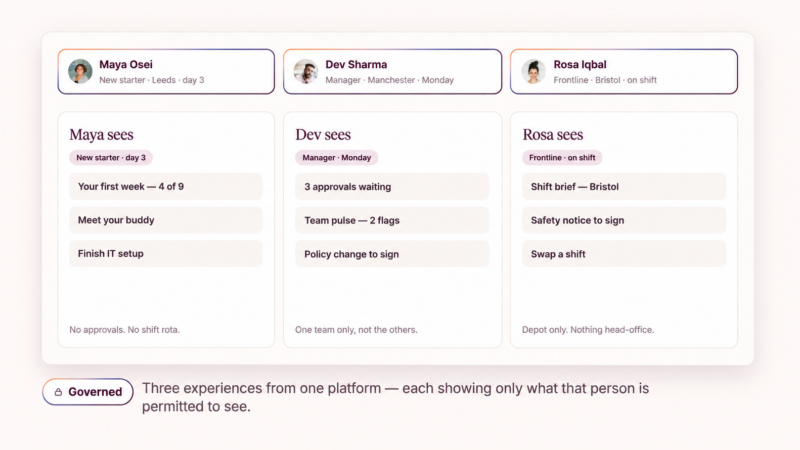
Role-based access control means AI respects the same permission structures as the rest of your platform. Not every employee should see every document – and an AI tool that doesn’t enforce role, location, and group-based permissions creates real compliance and reputational risks.
Compliance infrastructure means the platform meets your regulatory requirements, such as ISO, GDPR, or SOC 2, rather than creating new risk around them. Enterprise AI compliance requires documented data handling, certified standards, and the ability to constantly demonstrate compliance.
Auditability means every action the AI takes is recorded. When it provides an answer, surfaces a document, or makes a decision on an employee’s behalf, you must be able to see the AI’s thought process and trace it back. Without a complete, exportable log, there’s no way to show what the system actually did when a regulator, auditor, or affected employee asks.
Moderation means unacceptable content is caught as it’s created, not after it’s caused a problem. Compliance breaches, sensitive disclosures, and reputational risks can all enter a platform through a single page or comment. A platform that only catches these in hindsight is a reputational risk waiting to happen. Real-time detection closes that window before the AI can pick the content up and pass it on.
The table below compares how these requirements play out across ungoverned and enterprise-ready AI tools.
| Dimension | Ungoverned AI | Enterprise-ready AI |
| Content accuracy | Returns whatever it finds, accurate or not | Flags outdated, duplicate, and conflicting pages |
| Access control | Same results for everyone | Role, location, and group-based permissions enforced |
| Compliance | Left to the organization to manage | Regulatory requirements built in |
| Auditability | Little or no records kept | Full audit trails, review cycles, and sign-off workflows |
| Moderation | Issues caught after things go wrong | Real-time detection of compliance and reputational risks |
Interact delivers the enterprise-ready features as standard, not as an add-on or configuration. Duplicate warnings flag potential conflicts at the point of creation, governance alerts surface pages that have passed their expiry date before they can affect AI results, and compliance risks in content and comments are detected in real time.
Role, location, and group-based permissions apply throughout, on a platform built to ISO 27001, GDPR, and SOC 2 standards, with full audit trails for every user action. It’s the same governance that powers Interact’s embedded AI for employee experience, so the intelligence and the controls come from one system rather than two.
The result is a platform where governance is continuously running, so AI always has accurate, current, and compliant content to draw from.
Eight enterprise AI governance questions to ask vendors
Most AI vendors can answer confidently when asked about search quality, accuracy, or integrations. The questions that reveal more about enterprise AI governance are the ones about how the platform actually works day to day: who controls what, what the platform enforces automatically, and what it leaves to you.
The next time you’re considering an enterprise AI tool, lead with these questions to determine whether it’s truly enterprise ready.
- Is governance built into the architecture, or is it a settings layer? Ask the vendor to show you how access controls, content restrictions, and compliance features work. A settings layer means administrators manage governance manually. An architectural approach means the platform enforces it by default. The difference between the two becomes clear when things change, like new hires or policy updates. In these cases, a settings layer depends on someone remembering to update it, while an architectural approach adjusts automatically.
- Can you require content to pass through an approval process before it’s published? Ask the vendor to show you how the publishing workflow operates in practice. On platforms with built-in approval workflows, organizations can require content to go through editorial sign-off before it goes live, meaning nothing reaches employees, or the AI, without someone having reviewed and authorized it first. Some content won’t need that step, and that’s fine. What matters is whether the platform lets you require sign-off when you do, rather than the decision being made for you.
- How does the platform handle outdated content? Ask specifically: if a document passes its expiry date, what happens? Does the platform alert someone, flag it in a dashboard, or do nothing? The answer tells you whether content governance is proactive or reactive, and proactive is the only version that keeps AI results accurate.
- What can the AI surface to someone who shouldn’t have access to it? Ask the vendor to demonstrate the same query from two different user types, such as a corporate manager and a frontline employee. The results should differ in ways that reflect permission structure. If they can’t demonstrate this clearly, that’s a problem.
- Can the platform restrict content by location as well as by role? For global organizations, role-based permissions alone aren’t always enough. A document that’s appropriate for employees in one region may be restricted in another for regulatory, legal, or HR reasons. Ask whether location-based access controls exist and whether those restrictions carry through to what AI can surface.
- How does the platform handle access when someone’s role changes or they leave? Permissions set for a previous role don’t always disappear when that role changes. Ask what happens to a user’s access rights during offboarding or a role transition, whether it’s automatic or manual, and how long a lag typically exists between a change happening and access being updated. A former employee’s permissions remaining active, even briefly, is a meaningful exposure in an AI governance context.
- What audit trail does the platform provide for AI activity? In a compliance or regulatory context, “the AI returned it” isn’t an explanation anyone will accept. Ask what logs the platform maintains, whether they’re exportable, and how long they’re retained. This is often where governance-light platforms show their limitations most clearly.
- How do compliance certifications apply to AI specifically? A platform can hold ISO 27001 or SOC 2 certification while its AI features operate outside the scope of that certification. Ask explicitly how each standard applies to the AI capabilities, not just the platform overall. Real enterprise AI compliance needs to cover the AI itself.
As AI use in our workplaces continues to grow, governance will only get more important, and more complicated. The tools will keep piling up, and with the rise of agentic AI, more of them will start acting on their own rather than waiting to be asked. The organizations making a commitment to prioritize governance now are the ones that will be able to look at future tools clearly and say yes to the effective ones with confidence. Get your standards and your strategy right early, and enterprise AI governance stops being a hurdle and starts being the reason the reason your AI tools are more reliable than the competition.
Where to start with enterprise AI governance
Closing the enterprise AI governance gap starts with treating governance as a buying criteria rather than a post-purchase project. Especially as agentic AI becomes more widespread, the cost of operating without AI governance will only rise.
Internal policies are key as well. The organizations moving quickly on this issue, both by crafting strong AI governance policies and ensuring the AI tools they use are enterprise-ready, are building a foundation that lets them scale AI confidently when the next big advancement arrives.
Here are three places to start building an enterprise AI governance model for your organization:
- Get our AI usage policy template. It walks through every section a robust policy should cover and gives you a structure to adapt to your tools and risk profile.
- Read more on managing employee AI use day to day. Our blog on how to manage employee AI use in your workplace covers the policy and behavioral side of the governance conversation in depth, and our look at agentic AI for internal comms explores where this is heading.
- Talk to our team. If you want to see what enterprise AI governance looks like when it’s built into the platform rather than bolted on top, we’re ready to show you around.
Frequently asked questions
Most enterprise AI tools are built to perform in a demo, not to govern content, permissions, and compliance at scale. They can find answers and draft documents quickly, but they often can’t enforce who sees what, verify that information is current, or produce an audit trail. Enterprise AI readiness depends on those governance capabilities being built in, not added later.
Enterprise AI governance combines two things: an organization’s internal governance framework (its policies, ownership, and oversight) and the ability of its AI tools to adhere to, enable, and enforce that framework. A strong AI governance framework on paper means little if the platform can’t uphold it, so the two have to work together to keep AI accurate, secure, and accountable.
An enterprise-ready AI tool addresses five things together: content accuracy, role-based access control, compliance infrastructure, auditability, and moderation. Most tools cover one or two; enterprise-ready platforms handle all five before deployment. That means current and verified knowledge, permissions the AI respects, certified standards for enterprise AI compliance, complete audit trails, and real-time detection of risky content.
Ask whether governance is built into the architecture or just a settings layer, how the platform handles outdated content, and what the AI can surface to someone who shouldn’t see it. Ask for an audit trail of AI activity and how compliance certifications apply to the AI layer specifically. The answers reveal whether governance is enforced automatically or left to you.
Agentic AI acts on behalf of employees rather than just answering questions, which raises the stakes for every governance decision. Without strong agentic AI governance, an AI agent can act on data it shouldn’t touch or take actions no one can trace. As autonomy increases, the cost of weak governance rises, making enterprise AI governance a foundation for scaling AI safely.
You Might Also Like
 Blog
Blog How AI is changing the workplace in 2026
How AI is changing the workplace may be the defining employee experience question of 2026. Now that the experimentation phase of AI is over,…
 Blog
Blog An AI-powered intranet that moves from personalized to adaptive
An AI-powered intranet should make your day simpler and faster. Simple. Most workplace AI, however, has done the opposite: more tools, more messages, more…

 News
News Interact joins Anthropic’s Cyber Verification Program to build advanced cyber defence with Claude Mythos
Through Anthropic’s Cyber Verification Program (CVP), Interact’s security team has access to Claude Mythos 5.1, the most powerful model Anthropic makes available to verified…
 Blog
Blog Workplace AI: From what employers want to what employees need
Workplace AI can look successful on paper and even deliver business improvements while still falling short of what employees actually need. An AI-enabled intranet…