Email is not dead: what the data really says about employee newsletters


For more than 15 years, Interact has been building intranet and employee communications technology, working with more than 1,500 organizations worldwide, including Fortune 500 and Fortune 100 enterprises. After Interact’s recent online conversation, Dana Feldhacker, Head of Customer Success, makes the case for email newsletters.
The mission hasn’t changed, but communication has
Calling us an intranet company would do us a disservice. Interact is an employee experience platform with the intranet at the core, plus much more: email newsletter, a mobile-native app, digital signage, idea management, AI powered features and more. Earlier this year we ranked first in the ClearBox intranet and employee experience platforms report, which is great external validation. And our mission from day one has never changed, to inform and connect every organization’s greatest asset: its people.
In the last 30 years, the way organizations communicate with their people has fundamentally changed. The old approach, one message sent to everyone, one time, just does not work anymore. Three things have shifted:
- Workforces are distributed. In the not-so-distant past, most everyone sat at their desk at 9am, logged in at the same time and logged out at the same time. Today you have office-based staff, frontline workers and remote employees. Work is no longer a place you go, it’s a thing you do.
- Relevance is now non-negotiable. Employees are not ignoring email. They are ignoring comms that are not relevant to them. Your strategy has to account for that.
- Comms teams spend too much time building and not enough time thinking. This is crucial: emails should not take hours or days to build, and you should not have to chase designers and subject matter experts around the business. You should be able to build, measure and send all in one place.
The stakes to getting this right keep rising. Gallup’s State of the Global Workplace 2026 found that global employee engagement fell to 20% in 2025, its lowest level since 2020. The estimate put forward is that this plummeting engagement costs the world’s economy in the region of $10 trillion each year in productivity. With detachment building, communication that actually reaches and resonates with people matters more than ever.
The data: people really do read employee newsletters
Before getting to the platform, it’s worth leading with the numbers because they shape everything else. Interact’s own findings – not estimates – are based on real customer data.
Some of the findings are genuinely surprising, and the main twist is that employee newsletters have a 69% median open rate. That is two to three times what marketing emails get, which puts to bed the idea that email no longer works.
People read newsletters reliably, and they read them fast:
- 69% median open rate for employee newsletters
- 54% of opens happen within the first hour
- 83% of opens happen within 24 hours
- 2.3 opens per reader on average
In practice you have roughly a one day window to make your message land. That last number is a favourite: at 2.3 opens per reader, nearly half of your readers come back and read it more than once. They treat the newsletter as a resource, which is exactly what you want: read, clicked on, returned to.
The real question therefore is not whether the channel works. It’s whether you are getting the most out of it, and whether you can even measure what is happening as you send.
Three wins that make Interact’s email newsletter different
Integrated. The email newsletter tool sits inside the Interact platform. It is not a standalone tool you bolt on, it is built into your intranet, so your content, your audience groups and your analytics all live in one place. That matters enormously for efficiency. Many comms teams work across three or four tools: content in one, sending in another, analytics in a third, maybe design in a fourth, sometimes with a different team for each piece. With Interact you create, send and measure in one place.
Targeted. If a newsletter goes to 8,000 employees but part of it only applies to 400 of them, you lose people before they ever see anything that matters to them. With Interact you can personalise content by role, by location, and by audience groups you already have set up in your intranet. Instead of one generic blast, you send something that speaks to the person reading it, and that is how you recapture attention time after time.
Effortless. No need to be a designer or know how to code, and no more spending hours building from scratch. Interact’s editor is drag and drop, with branded templates, content blocks and reusable snippets. If you’ve ever wanted to try building an email before the kettle has finished boiling, now’s your chance.
What you can do today: give people something to click
Here’s a game-changing tip, whether or not you use Interact. There are two things that are measured in a newsletter: an open rate and a click through rate. The open rate is largely fixed by the sender and the subject line; there really isn’t much to play with. The click through rate is different, because it’s a function of what’s inside the email. Here there is a lot you can control.
This one should make everyone sit up: 62% of newsletters contain zero clickable links. None. For those sends, the open rate is almost irrelevant, because there is nothing to drive action on. You know the email was opened, but the data stops there. Where the data doesn’t stop is as follows:
62% of newsletters contain zero clickable links . 16% click to open rate for newsletters with 30 or more links . 93% of clicks happen in the body of the email, not the header or footer
That higher click to open rate is not because long newsletters are better. It is because more relevant links mean more reasons to act. And because 93% of clicks happen in the body, an important link buried in the header or footer is almost never seen.
Interact makes it straightforward to build link rich, structured newsletters: content blocks, calls to action, article previews and page previews that pull directly from content already created in your intranet. That is how you move people from simply opening an email to actually acting on it.
What about frontline and deskless teams?
A common assumption is that frontline workers, in retail, healthcare, logistics and similar roles, do not read newsletters. The data tells a more nuanced story, and as ever the truth is much more valuable.
89% of frontline employees have opened a newsletter by 7 days, compared to 91% open rate for desk based staff over the same period. Those numbers are almost identical.
The difference is timing. Desk staff tend to open around 8am, while frontline staff peak around 2pm: at lunch, after work, or before their next shift, often on their phones when they are not actually working. So, if frontline engagement looks low, you may have a timing issue rather than an engagement issue. A 24-hour open rate is not always the right measure for frontline audiences. You have to look holistically across the whole audience and measure their activity around their real-world behaviours.
How Edinburgh Airport cut production by 75%
An airport is an incredibly complex operation with a significantly diverse workforce, and Edinburgh is no different. Scotland’s busiest airport, with more than 16 million people through its doors in 2025, the airport mixes office staff alongside ground crew, maintenance, engineers, catering and cleaners, and constantly rotates teams to provide a round-the-clock service.
To keep staff up to date and invested, its comms team was spending a huge amount of time building newsletters every week. Titled ‘ The Weekly Edit’, the process was not integrated with their employee directory so the team had to manually reconcile subscribers lists each month. It made newsletter creation a time-consuming and unnecessarily repetitive task.
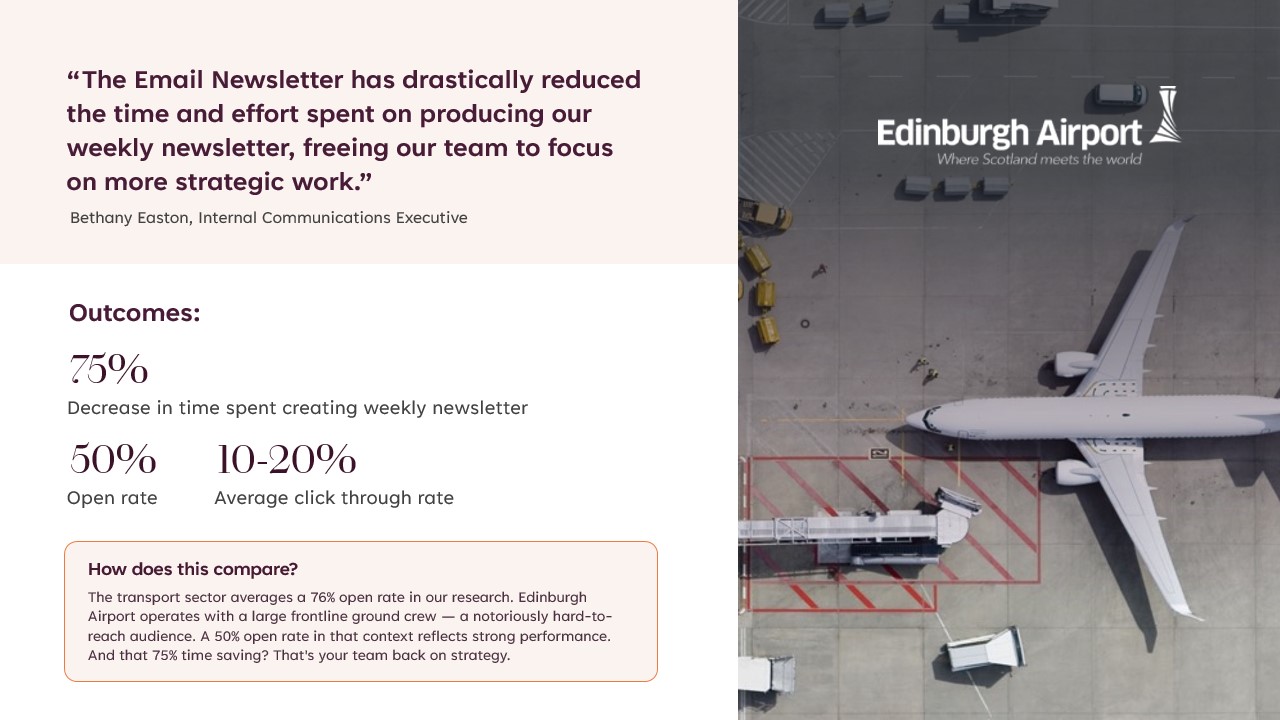
After onboarding Interact, the entire workflow was streamlined. The ability to duplicate newsletters and simply update the content removed significant time-sink, with a synced employee directory now replacing the need to maintain a separate distribution list. The team saw email newsletter production time fall by 75%, giving almost a full working day back every week to multiple staff members. Open rates jumped to 50%, with click through rates up to 20%.
A 50% open rate across a deskless heavy workforce is strong, and the operational impact keeps paying off week after week. It is a real result, not a hypothetical, made possible by Interact.
Three things to take back to your team
If you remember nothing else from the session, remember these:
- Email still works. A 69% median open rate, much of it within the first hour, says employees read relevant newsletters reliably.
- Give people something to click. With 62% of newsletters carrying zero links and 93% of clicks landing in the body, relevant links in the body are where action happens.
- Speed and targeting win. Most clicks happen on day one, so remove production friction and personalise to the groups you already have, rather than sending one generic blast.
You Might Also Like
 Blog
Blog Nine questions to ask intranet vendors: A checklist for your next demo
An intranet demo is designed to make the product look good. It’s easy to walk away impressed, especially now that AI is typically part…

 Blog
Blog Strategic internal communications: Connecting comms to business outcomes
Most communicators know strategic internal communications means connecting comms to business outcomes, but the majority aren’t doing it. The key is uncovering evidence that…
 Blog
Blog 3 essential intranet AI capabilities every organization should expect
Intranet AI capabilities can look impressive in a demo. The real question is whether they still work in the real world, when employees have…
 Blog
Blog How to measure employee engagement – and why
Knowing how to measure employee engagement has never mattered more, and the answer is within reach of every internal comms and EX leader.