Building AI that actually works for Internal Comms

There’s a question I keep hearing from IC and HR leaders, and it’s changed noticeably over the past year. A year ago, the question was: “Should we be using AI at all?” Six months ago, it became: “How do we use AI responsibly to elevate internal comms and employee experience?” Today, the question is sharper: “When does AI actually start doing something useful?”
It’s overdue. The workplace technology market has spent the better part of two years selling the idea of AI. The promise of transformation. Pilots full of potential. Demos that dazzle. Meanwhile, employees are still toggling between six apps to find answers, still logging into separate systems to complete workplace forms, and still manually reviewing every workplace thread and comment.
The between what AI promises and what it actually delivers is where most organisations are stuck. It’s happened before. Email spent years as a joke chain platform before it revolutionized how the world worked. It’s a fixture of technology evolution: we develop, we embrace, and then… we stagnate. But the difference now is that this time, the clock is running faster.
Trust in AI is already running out
Our AI Masterclass last month confirmed it. Of the 200 internal comms professionals who attended, 39% said AI outputs feel generic. Nearly one in five said they simply don’t trust AI at all. That’s not a technology problem, it’s a relevance and reliability problem: the tools exist, they just won’t do what people were told they would.
That 39%, as well as the 19% who have given up trusting AI altogether, is where the real battle for AI will be won or lost for our industry.
At Interact, we’ve spent the past few months trying to close that gap. Not by adding features for their own sake, but by asking a version of the same question I posed in my Autumn post: what are the real problems, and what’s the most effective way to solve them?
Our Spring Launch, announced today, is the answer.
Hunting season is over
Here’s what should bother every business leader: employees are still spending way too much time just looking for information. Not creating. Not collaborating. Not making decisions. Just searching.
And this isn’t just a leadership concern. Internal comms teams become very expensive search engines, because information isn’t missing, it’s buried in legacy systems that no one migrated, platforms that won’t communicate with each other, documents that most people have forgotten about. The answer they need to every question is split across multiple places, and they have to wrestle with a supposedly intelligent intranet to find any of it.
As I said in autumn: at Interact we don’t chase trends, we solve real problems. This is the exact problem our expanded AI Search was built to solve.
Our AI Search now reads the content inside uploaded documents, so a compliance handbook or onboarding guide isn’t just a file in a folder – it’s a source for real answers. And our new Workplace Connectors extend that search into the places where company knowledge actually lives. The result: people stop searching and start doing.
AI that earns its place
Until now, managing the risk of employee-generated content meant one of two things: the Comms team manually reviewing every single item or reluctantly accepting that things would occasionally slip through. As organizations open more spaces for the employee voice – community feeds, social posts, comment sections – the risk only grows.
Neither option scales. Manual review breaks at enterprise size – comms teams shouldn’t be reviewing comments at 10pm – and ignoring the risk is unacceptable. It’s why one of the capabilities I’m proudest of in this year’s Spring Launch is our new approach to intelligent content moderation. Here’s what we’ve done.
We’ve built an intelligent agent that monitors user-generated content, and acts on it. The agent will flag or remove material that doesn’t correspond to organizational values, so teams can encourage employees to speak their mind without carrying the impossible weight of policing every word that gets shared.
That’s what I mean about AI earning its place. Not AI that generates content for you, which just adds to your trust problem. AI that actively protects the environment where your people communicate. It’s a huge distinction, and it’s part of the broader direction we’re heading in: AI capabilities that take responsible action on behalf of your organisation.
Same answer I gave in autumn again: solving real problems for real organizations.
Making the intranet the place you start your day
There’s a third thread in our Spring Launch, something we’ve believed for a long time: the intranet should be where work starts.
Every time someone leaves the intranet to complete a routine task, that’s a small moment of friction. Individually, each one of those is trivial, but multiply those moments across thousands of employees and hundreds of working days, and they represent a real drag on productivity and engagement.
Our expanded Workday integration eliminates some of those friction points entirely. HR teams have been trying to reduce the number of systems employees touch for years, and this is a concrete step toward that goal. Key HR workflows now live inside Interact, so employees can complete everyday tasks without leaving. The logic is simple: the fewer reasons to leave, the more the intranet becomes the genuine hub of someone’s working day.
And the benefit of a personalized, relevant platform doesn’t only impact users: IC and HR teams leverage automated analytics to prove what’s working and the content employees are engaging with.
Combined with a new social authentication method for our mobile app that allows deskless employees sign in with the same credentials they already use, we’re also removing that friction at the front door. For frontline teams, the barrier to entry has always been too high and that changes now.
What this adds up to
Before our winter launch , I outlined three outcomes for 2026: connect activity to business results, remove friction from everyday work, and scale what works across whole organisations.
This Spring Launch delivers against all three.
Deeper integrations reduce the reasons to leave the platform you’re building. AI Search reduces the friction of finding information. Intelligent moderation reduces the risk that comes with amplifying employee voice. These are not isolated features, they work together to make the employee experience more coherent, more productive, and more trusted.
It’s worth noting that Forrester named Interact a Strong Performer in their recent Intranet Platforms evaluation. That recognition came from the work I’ve described: adding intelligence to the platform and making it trustworthy enough to act on its own.
The underlying themes of our roadmap – AI that acts; experiences built for how people work; measurable outcomes that prove business impact – will continue to shape what we build through the rest of this year and beyond.
We built this Spring Launch for the organisations that are done with demos, and expect delivery. I hope it shows.
Read more about our Spring Launch here.
You Might Also Like
 Blog
Blog 3 essential intranet AI capabilities every organization should expect
Intranet AI capabilities can look impressive in a demo. The real question is whether they still work in the real world, when employees have…

 Blog
Blog How to measure employee engagement – and why
Knowing how to measure employee engagement has never mattered more, and the answer is within reach of every internal comms and EX leader.

 News
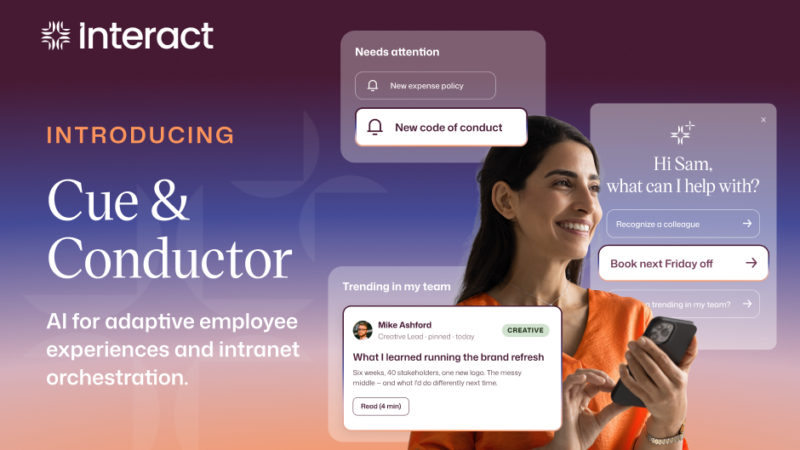
News Interact launches Cue and Conductor to create an AI-native intranet that adapts to what every employee needs next
Interact has launched Cue, an adaptive AI intranet experience that personalizes what every employee sees, knows, and does next. Cue launches alongside Conductor, Interact’s…

 News
News 62% of communicators say meaningful engagement includes employee action, but only 8% connect the data
New research from Interact and Ragan Communications identifies an “action-to-decision gap” between the outcomes internal communications teams want to influence and what their current…